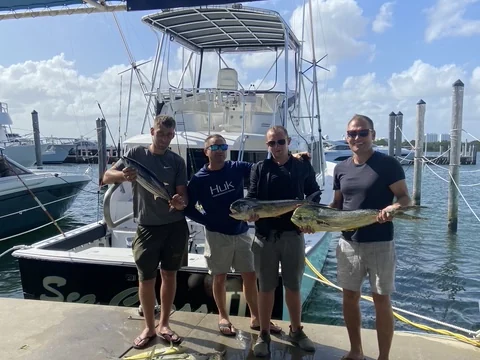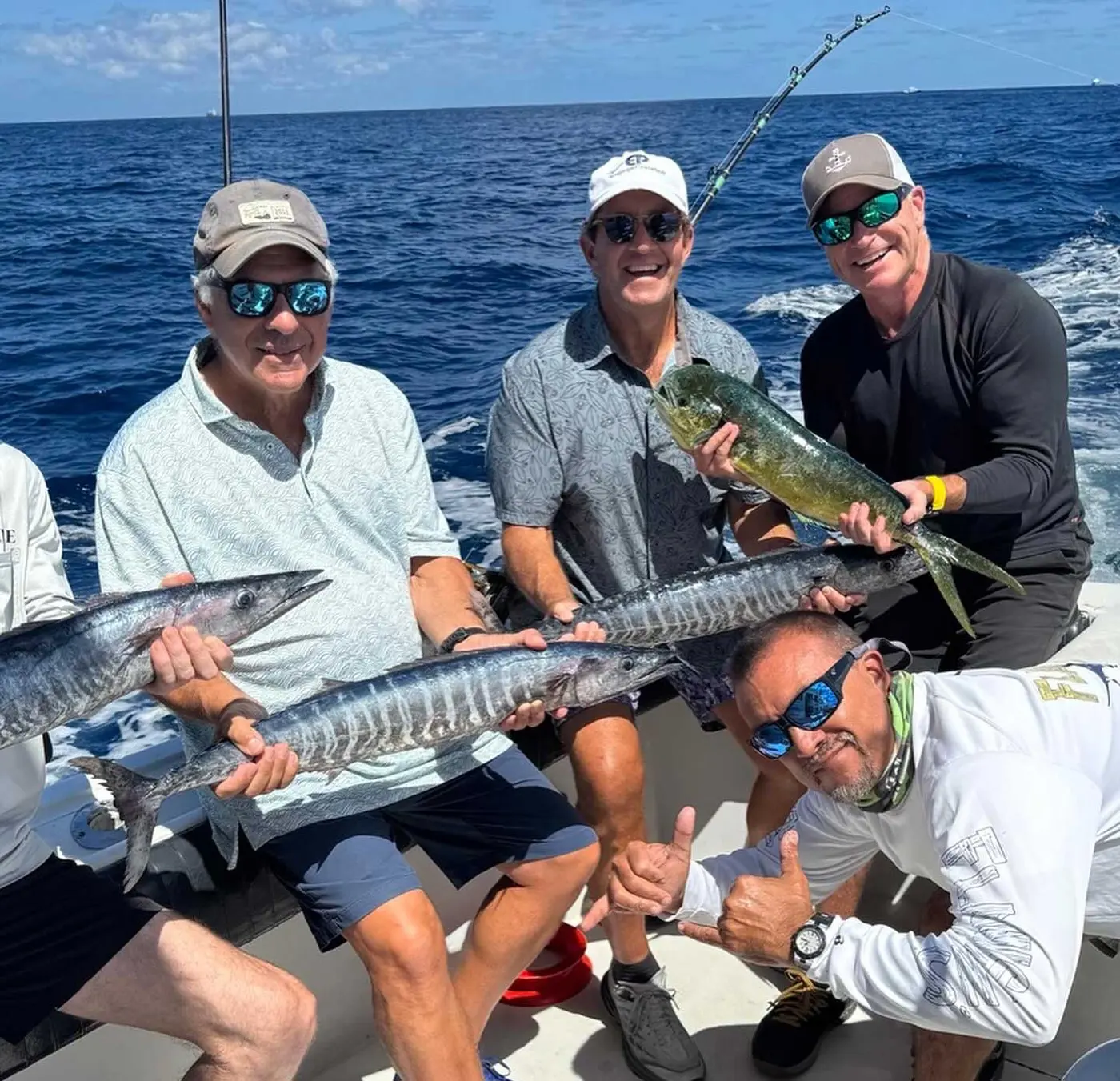
June dolphin came steady from 400 feet out to 1000, with bulls and cows to 35 pounds mixed into the schoolies and wahoo waiting under the boards.
Summertime Is Here and Fishing Is Heating Up
Summertime is here and fishing is starting to heat up offshore. June is when the seas flatten out along this coast and the long runs become comfortable again. That single change opens up half the ocean.
Most of the winter we fish inside, close to the reef, because the weather dictates it. Once the fronts stop coming, we can point the bow east and keep going until we find what we want.
The heat is the other story of the month. Fish feed early and late and slide deeper in the middle of the day, so the schedule matters as much as the location.
Bottom fishermen are getting ready too, because grouper season opens and the muttons gather again on the full moon.
Mahi From 400 Feet Out to 1000 Feet
We have been getting into mahi regularly from 400 feet all the way out to 1000 feet. That is a wide band of water, and the fish move around inside it depending on where the weed and the current set up.
I do not fish a depth so much as I fish a feature. A color change in 500 feet is worth more than empty blue water in 900. The number on the sounder is a starting point, not a destination.
Current eddies are the other thing I hunt. Where the Gulf Stream spins off a swirl, bait piles up on the edge and everything else follows it in.
Covering that much water takes time, which is why our full day offshore fishing charters get booked solid through the summer.
Schoolies, Bulls and Cows
The dolphin have generally been in the 6 to 12 pound range, with bulls and cows up to 35 pounds occasionally showing themselves amongst the schoolies. That mix is typical for June out here.
Bulls are the ones with the blunt square forehead, and cows have the rounded profile. The big ones usually travel at the edge of a school rather than in the middle of it, hanging back and picking off what the little fish push around.
When a big fish shows, everything changes. We pull the small baits, put something substantial in front of it, and try not to spook it with a tangle of hooked schoolies.
A 35 pound bull on light tackle is a proper fight, with long runs and repeated greyhound jumps.
Ballyhoo and Plugs Are Doing the Work
Lately, the fish have been eating ballyhoo and plugs well, without the need for live bait. When mahi are that aggressive it simplifies the whole day, because we can cover ground on the troll instead of stopping to catch bait.
Rigged ballyhoo is the most versatile offshore bait there is. Skipped on the surface or swimming just under it, that profile looks like food to nearly everything that swims out here.
Plugs earn their place when the fish are competitive. A hard lure takes abuse from twenty hungry schoolies without falling apart, and it gets back in the water faster.
When the bite gets picky, we go back to live bait and slow the whole presentation down.
Wahoo Under the Boards and Weed Lines
We have also had our share of wahoo hookups, finding them under boards or weed lines while dolphin fishing. Wahoo use the same floating structure as the mahi, but they use it from below.
The mahi sit right up in the weed, picking at small bait in the shade. The wahoo hangs thirty or forty feet down, out of sight, waiting for something to separate from the group.
That is why I always send something deep beside a good weed line. A live bait on a weight or a heavy jig dropped straight down will find them when nothing on the surface can.
They hit at frightening speed and the first run is unforgettable. Keeping steady pressure through it is the whole battle.
Tripletail are the other weed line bonus nobody expects. They lie on their side near the surface looking like a piece of floating trash, and they are among the finest eating fish in the ocean. Some people compare the texture to lobster.
Blackfin Migrating the Reef Lines
As is typical for this time of year, the reef lines have seen a consistent migration of blackfin tuna. They follow the bait along the outer edge and they are dependable if you catch them at the right hour.
Blackfin want low light. Overcast mornings, the first hour after sunrise and the last hour before dusk are the reliable windows. Bright midday sun on flat water shuts them down.
Look for them beyond the reef in water up to about 300 feet, often busting on the surface with birds overhead. Chumming with live pilchards is the standard approach, and trolling small feathers works when bait is short.
They are excellent on the table fresh, and they pull far harder than their size suggests.
Kingfish on Drone Spoons and Planers
The kingfish on the reef have also been a safe bet on drone spoons and planers. Summer kings are less concentrated than the spring run, but they are there every morning if you work the edge.
A spoon behind a planer covers water and finds them quickly. Once we know which stretch holds fish, we slow down and put live baits in the same zone.
Summer kings tend to sit deeper as the day heats up. Adjusting the planer depth by ten or fifteen feet is often all it takes to turn a dead troll into a busy one.
If you want to combine a reef troll with a short offshore push, our 3/4 day fishing charters hit the sweet spot for time.
Mahi Fun and Good Eats
There is a reason the title of this report mentions good eats. Fresh dolphin is one of the best fish anyone can put on a grill, and it is at its peak the day it comes out of the water.
Care on the boat decides how good it tastes at home. We bleed the fish, get it buried in ice immediately, and keep it out of the summer sun. A fish left on a hot deck for an hour is never the same.
The mate handles the cleaning dockside and will cut the fish however you like. Thick portions hold up better on a grill, while thinner cuts suit a pan.
Bring a cooler for the ride home, since we do not ship fish. Most of our private fishing charters in Miami come back with plenty to share.
Sailfish Whenever the Current Is Right
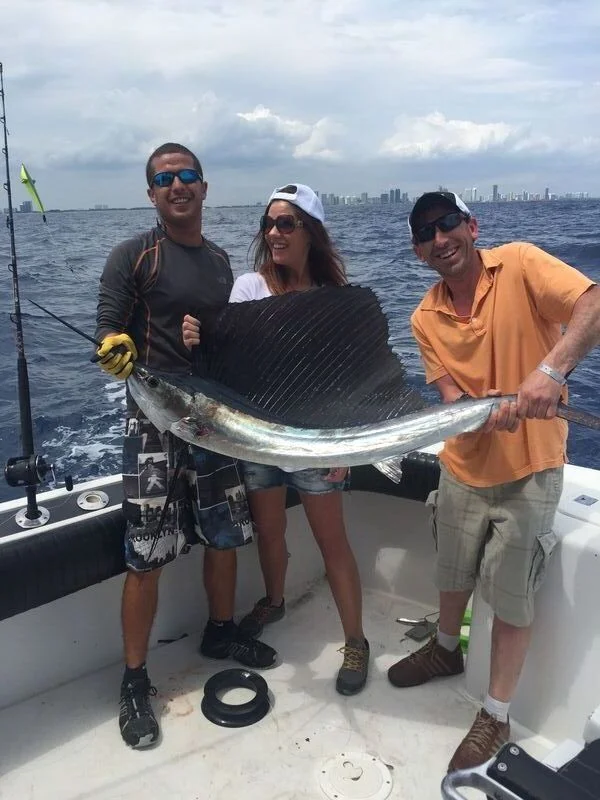
Last, but certainly not least, this is Miami, and if you can find good live bait, sailfish are always a strong possibility year round. People associate them with January, and they are wrong to write off the rest of the calendar.
When conditions are right, like a good north current and favorable winds, multiple hook ups of sailfish are the norm rather than the exception. Those days can happen in June just as they can in December.
What matters is bait quality. A fresh, frisky goggle eye or a big pilchard swimming naturally is what gets a sailfish to commit.
They hold in the 75 to 250 foot corridor that runs the length of our South Florida fishing charters coastline.
See You on the Rip
Summer out here is the friendliest fishing of the year. Calm water, long days, plenty of fish, and a cooler full of mahi fillets at the end of it. Hard to argue with any of that.
Bring sun protection and plenty of water, because heat is what wears people down in June. Everything else about the month is easy.
Get me on (305) 773-2282 and let us find a day with the right current. See you on the rip and tight lines.
Tight lines and stay safe, Capt. Ralph
Sea Cross Sportfishing, Miami Beach
Fish The Same Water
Capt. Ralph runs these trips out of Bill Bird Marina at Haulover Park. Call (305) 773-2282 to talk dates with Capt. Ralph, or browse the rest of the Miami fishing reports from the log.