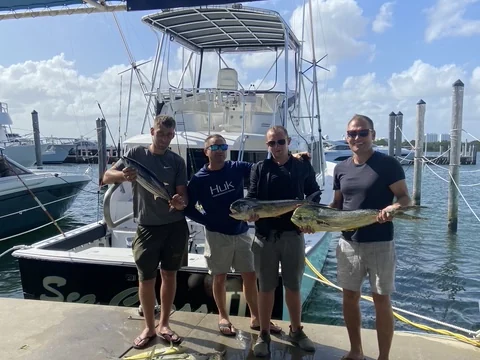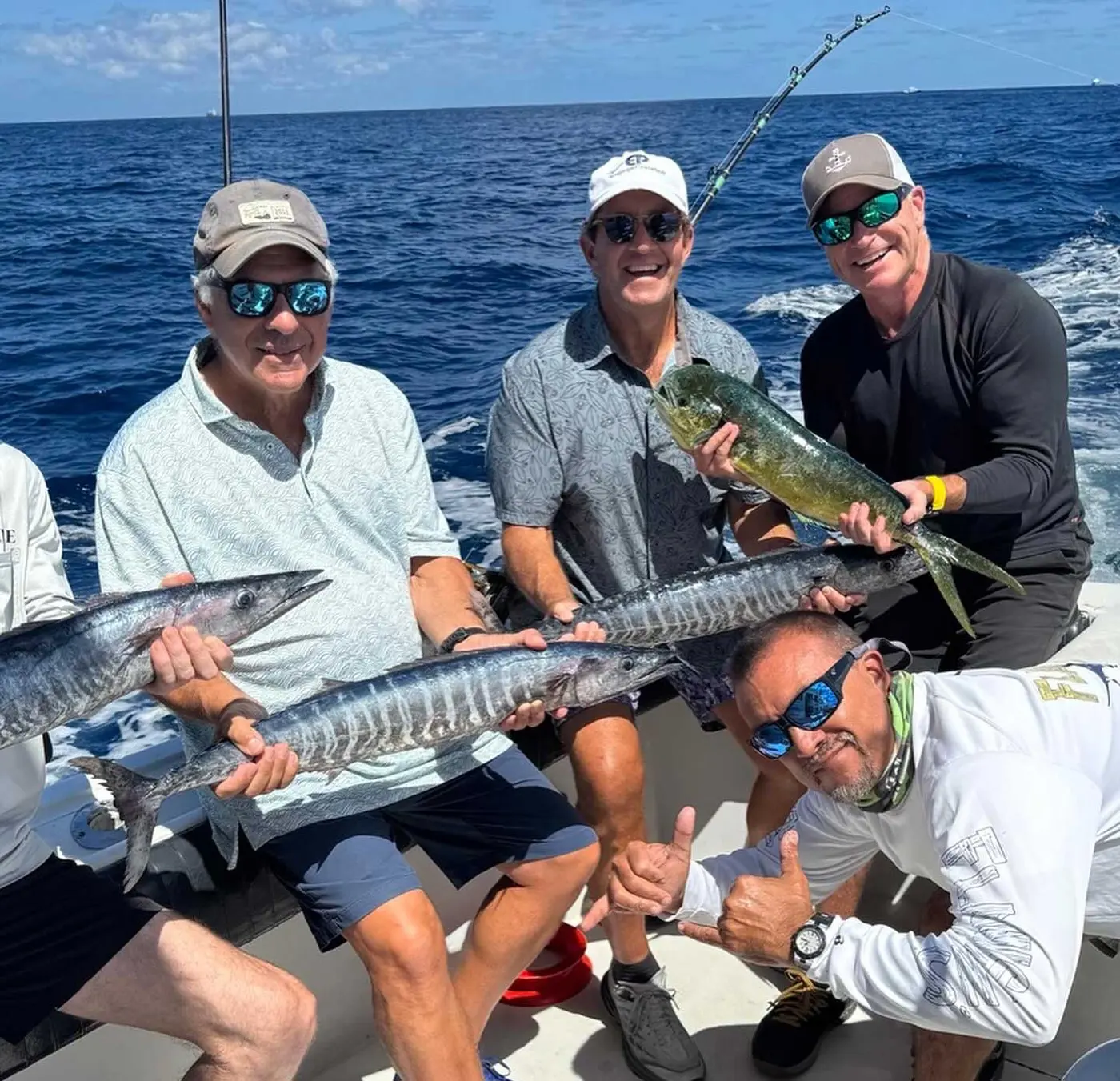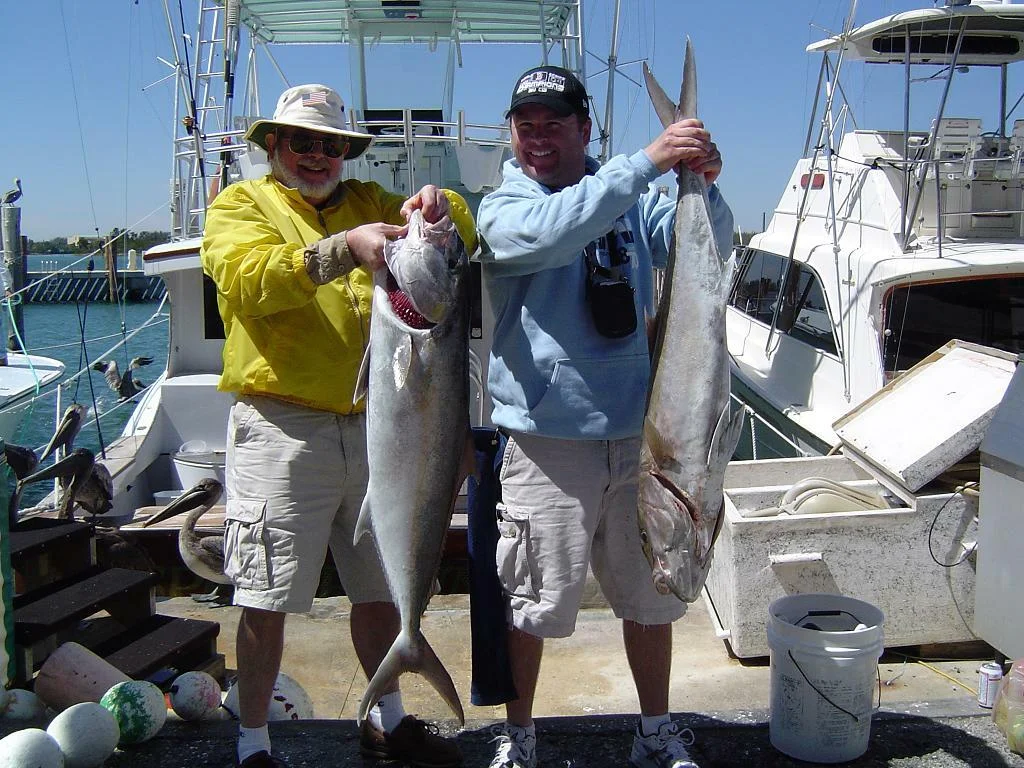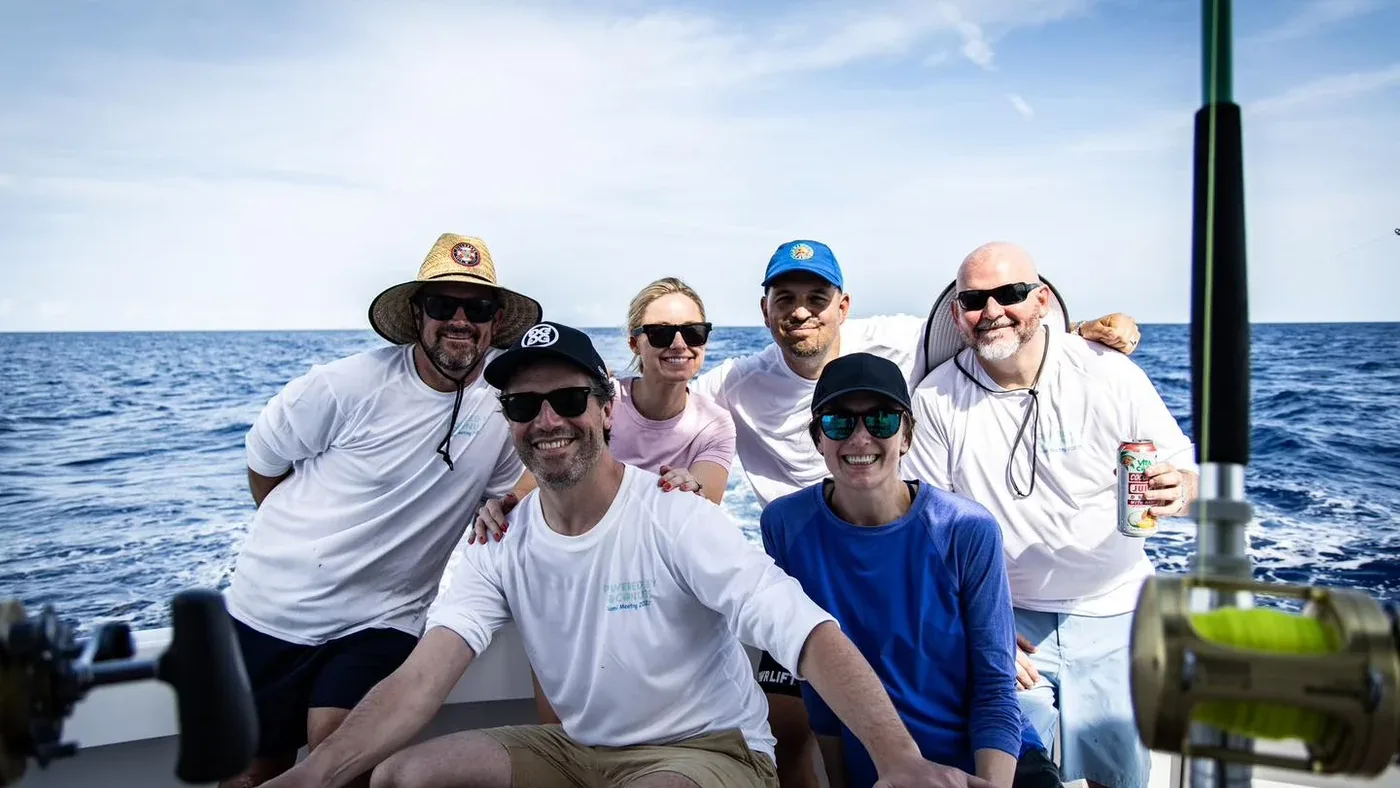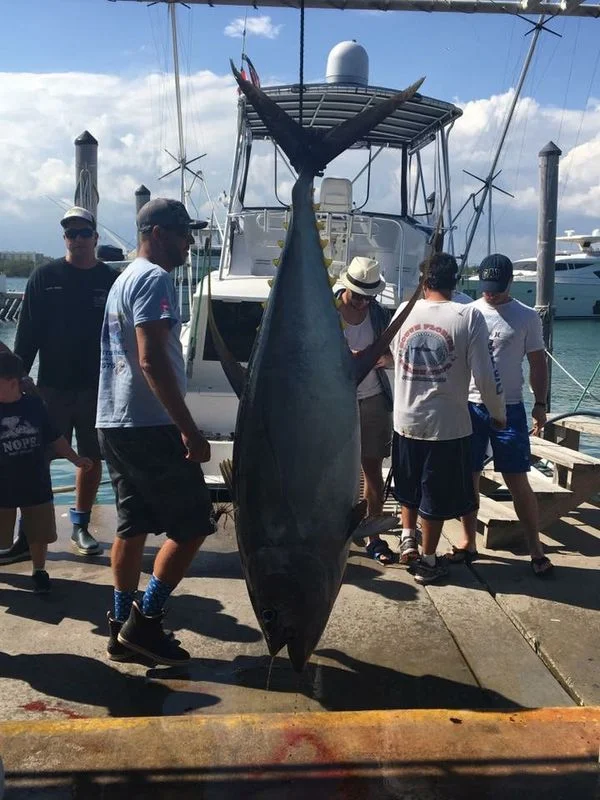
October turned the bite on. Mahi and wahoo eating ballyhoo and plugs offshore, sails to 75 pounds on the reef, and mutton snapper stacking on the wrecks.
Fishing Has Been Red Hot
Fishing has been red hot. We have been catching lots of mahi mahi and wahoo offshore, and they have been hitting on the troll. October turns a switch along this coast and everything gets easier for a few weeks.
The reason is the fall bait migration. Water up the Atlantic seaboard is cooling, the baitfish head south for the winter, and every predator in the ocean falls in behind them.
Where the food goes, the fish follow. That is the whole rule of this coast, and October is when it becomes impossible to ignore.
The mackerels lead the parade, with everything else working the edges of it.
Eating Ballyhoo and Plugs on the Troll
They have been eating ballyhoo and plugs. When fish are feeding that aggressively you do not need to complicate the spread, and trolling lets you cover far more water than sitting still does.
Rigged ballyhoo is the most useful bait offshore. Skipped across the surface or swimming just beneath it, that shape reads as food to nearly everything out here.
Plugs hold up when the bite is frantic. A hard lure survives a dozen strikes without needing to be re-rigged, which keeps it in the water where it belongs.
Once we find a productive stretch, we work it repeatedly rather than pushing on looking for something better.
Spoons and Billy Baits on the Wire
On the wire it has been spoons or billy baits. Wire line gets an offering down below the surface layer without needing a planer, and it runs clean at speed.
Spoons give you flash and a wide wobble that mackerel and wahoo can see from a distance. They work best when the water has a little color in it and the fish are hunting by sight.
Billy baits are a different tool. They swim with a tight action and hold together through repeated strikes, and they shine when the fish want something moving fast.
Both go deep on wire, which is exactly where the fall fish have been sitting.
When a Wahoo Hits, You Will Know
When a wahoo hits, you will know. It rips 200 yards fast. There is no question, no tentative tap, just an explosion and a reel you can hear from the bridge.
If you are not on the fish he will strip you. Two hundred yards disappears in seconds, and an angler who is slow getting the rod out of the holder can watch a whole spool leave.
That first run is the only truly dangerous part of the fight. Once it stops, a wahoo usually gives up faster than its size would suggest.
Drag settings get checked before we ever put baits out. Adjusting under load is how people lose fish and burn thumbs.
Keep Tight and Inch Every Bit of Line Back
So keep tight and inch every bit of line back into your reel that you can. That is the entire technique, and it works on almost everything that swims out here.
Slack is the enemy. A wahoo shakes its head violently, and a loose line lets the hook work free of a mouth that is mostly bone and teeth. Steady pressure keeps the point buried.
Short pumps beat long dramatic lifts. Raise the rod a foot, wind down a foot, and repeat until the leader shows. Long sweeps create slack at the top of every stroke.
Nobody needs to be strong to do this correctly. They need to be patient and consistent.
Your Mate Is a Vital Ally
It is important that you listen to your mate, as he is a vital ally in this battle. He will be ready with gaff in hand to stick your trophy fish, whatever it may be. So do not forget.
The mate sees things the angler cannot. He is watching the line angle, the leader, the direction of the fish and the position of the boat all at once, and he will call the shots.
When he says stop winding, stop. When he says lift, lift. A gaff shot happens in a second and a half and the angler controls where the fish is at that moment.
Our crew handles the rigging, the clearing and the gaffing on every trip so guests can fish.
Fall Weather Off This Coast
October weather is usually kind here. The summer heat backs off, the humidity drops, and the first weak fronts start sliding through without much wind behind them yet.
Those early fronts are worth watching. Each one nudges more bait south and improves the odds on sailfish, and the day or two after a front often fishes better than the week before it.
Hurricane season is still technically open, so we keep an eye on the tropics. If a system threatens, the captain makes the call and nobody argues with the ocean.
Our private Miami Beach fishing charters stay flexible on timing, which helps a great deal in a month that changes this fast.
What Comes On Board With Us
Every trip covers bait, terminal rigs, ice and the Florida license for everybody aboard. The rods come from Biscayne Rods and the reels are Daiwa, Penn and Shimano running fresh line.
The two vessels are air conditioned Hatteras convertibles rigged with outriggers, live wells, radar and up to date electronics. They are insured and run by Coast Guard licensed captains.
Wire line outfits, planers and spoons stay rigged through the fall because that is what the season calls for. Live bait gear rides alongside them for the sailfish shots.
Specifications for both vessels sit with our charter fleet of Hatteras convertibles, including the 55 foot boat stripped and rebuilt in 2022.
Kingfish and Sails Eating Our Offerings
Also on our reef trips, kingfish and sails are starting to eat our offerings. The average sailfish has been in the 60 pound range, with some tipping the scales at 75 pounds.
Those are strong fall fish. Early migratory sailfish join the local resident population around this time and give us real shots when the conditions cooperate.
For sailfish, that usually means wind out of the northeast. A north wind pushing against the Gulf Stream raises a swell the fish ride south, and it keeps them near the surface.
Our Miami deep sea fishing season guide shows how quickly that opportunity improves from October into November.
Muttons on the Wrecks in 80 to 150 Feet
On the bottom, mutton snappers are starting to show up on wrecks in 80 to 150 feet of water. That is comfortable depth to fish and it makes for a productive change of pace on a longer trip.
Muttons prefer the edges of a wreck rather than the inside of it. They patrol the sand and rubble nearby hunting crabs and small fish, so a bait set on the bottom alongside often outperforms one dropped into the steel.
Long leaders matter for them in clear water. So does a quiet approach and a well set anchor, since they spook easily in that depth.
They are outstanding eating, which is why every angler on board wants one in the box.
Yellowtail and mangrove snapper share the same structure in the fall and feed well after dark. A chum slick over hard bottom brings all three to the boat on a calm night. That is a very different trip from trolling, and a relaxing one.
October Is the Transition Month
October is the changeover along this coast. Summer patterns break down, the bait starts running south, and the fall targets stack up on top of each other for a few good weeks.
Bonito are still thick on the deeper reefs. Blackfin tuna, dolphin and wahoo hold along the deeper edges. Kingfish and Spanish mackerel arrive in numbers, and the sailfish odds climb with every front.
Having that many options is exactly why a longer trip pays off now. Our full day charter trips off Miami Beach let us troll, drop on a wreck and still work the reef.
Tight lines and stay safe, Capt. Ralph
Sea Cross Sportfishing, Miami Beach
Fish The Same Water
Capt. Ralph runs these trips out of Bill Bird Marina at Haulover Park. Call (305) 773-2282 to talk dates with Capt. Ralph, or browse the rest of the Miami fishing reports from the log.