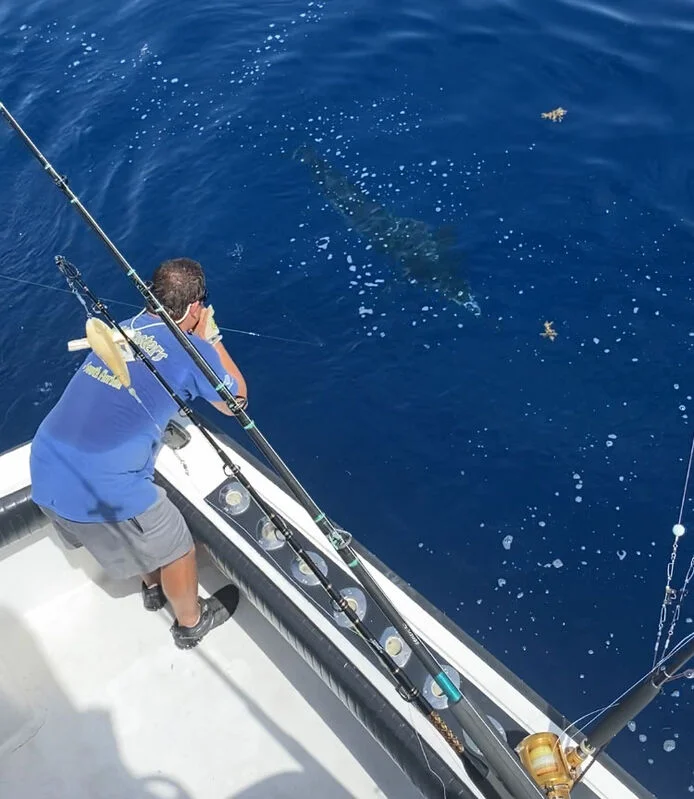
A short notice half day turned into the fish of a lifetime. A 350 pound blue marlin ate the right long ballyhoo in 800 feet, in clear view of South Beach.
A Call From An Old Customer
We were at the dock Sunday afternoon when I got a call from an old customer of mine named Robert McCreary of New York. He has gone out fishing a few times with us, and he was heading down on short notice with his daughter.
They were just getting away, doing a father and daughter deep sea fishing trip. So we booked a half day for Tuesday morning of that week.
A half day fishing charter gives us plenty of time to reach the Gulf Stream and look for mahi-mahi, wahoo, tuna, sailfish and the occasional blue marlin. The occasional part is the key word, and on this trip it stopped being occasional.
Repeat customers are the best part of this business. Robert knew the boat, knew the crew and did not need the first hour of instruction, which meant we could fish hard from the start.
Starting On The Third Reef
The day started like normal on the third reef, trolling south in 125 feet of water using bonito strips and fresh caught ballyhoo on extra strength 9/0 hooks. That is usually what we fish with.
Within the hour we had a few bonito and a kingfish in the boat. A slow morning on the reef is still a productive morning here, and those early fish keep everybody engaged while we look for something better.
When we deep sea fish Miami Beach, we usually run a six rod spread. Two ballyhoo, two teasers with birds and feathers on the outriggers, and we are always fishing with planers on braid.
That spread covers three depths at once. Surface baits for mahi and billfish, teasers to raise fish from a distance, and planer baits running deep for wahoo, kings and tuna.
After fishing the reef for about an hour, we were far enough south to be in front of Key Biscayne. So we started heading offshore looking for weed lines, birds and debris.
Schoolies In 800 Feet And A Bird On A Sandal
On our way back north we were just in front of what we call the double diamonds off Miami Beach. In 800 feet of water we started catching a few schoolie dolphin.
Schoolie mahi are a good sign, not just a good time. They mean bait is in the area and the water is alive, which is the same reason bigger predators end up there.
As Captain Peter started heading down the rip, he noticed a bird sitting on what seemed to be a sandal. A sandal is enough. Any floating object out here creates shade and holds bait, and a bird sitting on it means it has been there long enough to matter.
So he made a long sweeping turn to pass by it. That is standard practice, and it is why we look at every scrap of debris we pass even when nothing appears to be happening.
As he came around, the right long ballyhoo started to submerge under the water. That is when all hell broke loose.
A 350 Pound Blue Marlin Eats The Ballyhoo
A beautiful 350 pound blue marlin ate the ballyhoo and started ripping line off our 30 wide Penn International reel.
We pack those reels with over 500 yards of 40 pound Ande mono, which is my line of choice. That capacity is the only reason a fish like this is landable on a half day trip. A marlin takes what it wants on the first run and you simply have to let it go.
Before you know it, Robert was fighting a fish of a lifetime. His daughter was right behind him videotaping the whole battle, right in front of Miami Beach and South Beach, with a clear view of Key Biscayne just to the south.
It was unbelievable the amount of jumps this fish made during the 45 minute battle. Every jump is a chance for the hook to come free, and every one of them had the whole cockpit holding its breath.
We finally got the fish boatside and landed on the leader, with beautiful pictures right next to the boat. Then we let her go. We always release these epic fish.
Leadering a marlin is the most dangerous moment of the whole fight. The fish is green, the boat is close, and a mate has hundreds of pounds of angry billfish on a wrap of mono. Everyone has a job and nobody stands where they should not.
Why A Blue Marlin Off Miami Is So Special
Blue marlin are a rare catch off Miami, and that is what makes them such a special moment in an angler's career. You can fish this coast for years and not raise one.
They are here, though. The Gulf Stream runs within a few miles of the beach and marlin travel that current, which is why a fish like this can eat a ballyhoo in 800 feet within sight of the hotels.
Most of the blues we see come in the warmer months, on the same spread we pull for mahi and tuna. You do not target them specifically on a half day. You fish properly, you check every floater, and occasionally you get lucky.
Heavy enough tackle matters. If we had been fishing light gear that fish would have spooled us in the first run. Our reels carry the line capacity and the drags to handle it, and every reel in our Miami charter fleet gets fresh line regularly.
Even more special was that it happened on a father and daughter charter fishing trip. It was a trip they will never forget, and neither will I.
Checking Every Piece Of Debris
A bird sitting on a sandal is the whole lesson from that trip. Offshore, anything floating is a piece of structure, and structure in open ocean is rare enough that fish use all of it.
The sequence starts with small life. Barnacles and weed grow on the object, tiny baitfish gather in the shade, then larger bait arrives, then predators. A board that has been drifting for weeks can hold an entire food chain under it.
Birds are the giveaway. A frigate or a tern sitting on something has usually been there a while, and it is sitting there because there is food below.
How you approach it decides everything. I never drive straight over a floater. I make a long sweeping pass on the down current side so the baits swing past it naturally, exactly like the turn that produced this marlin.
Then I look at it again. If nothing eats on the first pass, a second approach from a different angle often does. Fish position themselves relative to the current, not to my boat.
Most of the time you get a few mahi. Occasionally you get a wahoo. And once in a while you get a blue marlin, which is why we check every single one.
Booking Your Own Shot At A Billfish
Robert's marlin came on a half day fishing charter, which surprises people. Four hours is genuinely enough time here because the deep water starts so close to Haulover Inlet.
That said, if a billfish is the goal, more hours means more chances. On full day fishing charters we can fish the reef, run the edge, check every floater and still have time to set kites when conditions call for it.
Timing helps too. Summer is prime for blue marlin and mahi, while winter is peak sailfish season with cold fronts and north winds stacking fish in the 70 to 250 foot corridor. Our Miami deep sea fishing seasons calendar breaks it down month by month.
Bait, tackle, ice, coolers and Florida fishing licenses are included. Our Miami Beach fishing charters put you on the water minutes from the Gulf Stream.
Tight lines and stay safe, Capt. Ralph.
Sea Cross Sportfishing, Miami Beach
Fish The Same Water
Capt. Ralph runs these trips out of Bill Bird Marina at Haulover Park. Call (305) 773-2282 to talk dates with Capt. Ralph, or browse the rest of the Miami fishing reports from the log.